Your Supply Closet Is Gaslighting You: How to Run a Real Paper Audit
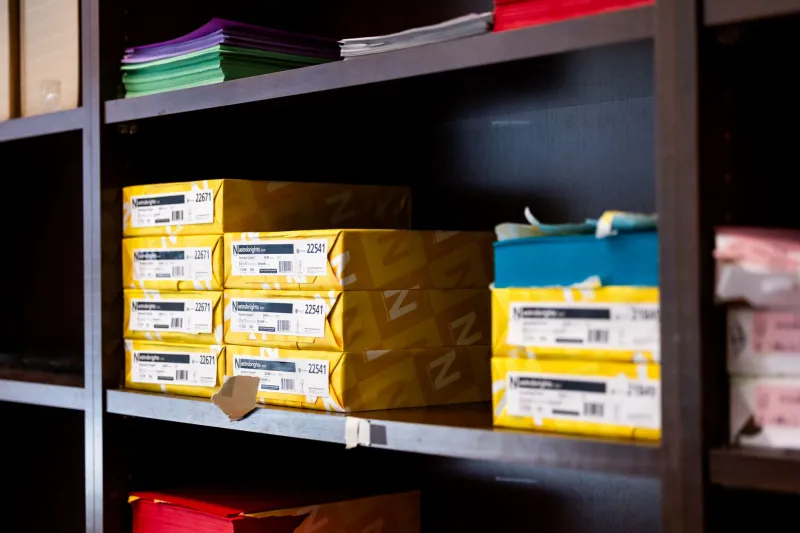
Somewhere in your office — behind the printer, under the folding table, or jammed into the cabinet nobody opens — there's a graveyard. Sticky notes in a size nobody likes. Legal pads from a vendor who gave them away at a trade show four years ago. Three kinds of printer paper, none of which is actually the right weight for your letterhead. A box of index cards someone ordered optimistically in 2021.
This is the supply closet lie: the idea that having a lot of paper products means you're prepared. In reality, most businesses are simultaneously overstocked on things they never use and perpetually scrambling for the specific items people actually need. The result isn't just a messy closet — it's a quiet, ongoing drain on your budget and your team's time.
A real paper audit fixes that. It's less glamorous than a productivity app overhaul, but it often delivers faster results.
Why Businesses Get This Wrong in the First Place
The accumulation problem usually starts with good intentions. Someone orders in bulk to save money. A vendor sends samples. A well-meaning office manager stocks up on variety "just in case." Over time, the closet fills with products that represent aspirational workflows rather than actual ones.
There's also the inertia factor. Most offices reorder whatever they ordered last time without stopping to ask whether anyone is still using it. The purchasing decision gets made on autopilot, and nobody notices until the budget gets scrutinized or someone spends twenty minutes hunting for the one notebook that works for their meeting style.
The real problem isn't waste — it's misalignment. Your paper products should reflect how your team actually works, not how you imagined they'd work when you placed that last bulk order.
Step One: Pull Everything Out and Get Honest
A proper audit starts with a physical inventory. Yes, that means actually pulling things off shelves and counting them. It sounds tedious, but you can't fix what you haven't seen clearly.
As you go, sort into three categories:
Active — products people regularly request or reach for without being reminded they exist. These are your workhorses.
Occasional — items that have a legitimate use case but aren't daily drivers. Specialty envelopes for client mailings, for example, or cardstock for quarterly reports.
Phantom — everything that's been sitting there untouched. These are the honest items. The ones that reveal the gap between what you thought your team needed and what they actually do.
Don't skip the phantom column. That's where the real audit data lives.
Step Two: Map Usage to Actual Workflows
Once you know what you have, the next step is understanding why certain products aren't moving. Sometimes it's quality — people avoid the cheap notepads because the pages curl and the ink bleeds. Sometimes it's format — letter-size paper for a team that primarily prints half-sheet forms. Sometimes it's just that the original use case no longer exists.
Talk to the people who actually use the supplies. Ask them what they wish they had more of. Ask what they avoid. You'll be surprised how often there's a strong consensus around a specific product — a particular ruled notebook, a heavier bond paper for client presentations — that nobody ever thought to standardize on.
This conversation also surfaces hidden workflows. Maybe the sales team has been buying their own notebooks with personal money because the office supply never stocks the right size. That's a workflow gap disguised as a personal preference.
Step Three: Audit Your Paper Quality, Not Just Quantity
This is the part most businesses skip entirely. Not all paper is equal, and the wrong weight or finish for a given task creates friction that quietly slows people down.
A few things worth examining:
Printer paper weight. Standard 20 lb paper works fine for internal drafts, but if you're printing client-facing documents, proposals, or anything that needs to feel substantial, you want at least 24 lb — ideally 28 lb or higher. The difference is immediately noticeable when someone picks it up.
Notebook ruling. College rule, wide rule, dot grid, and blank pages serve genuinely different thinking styles. If your team is mostly using notebooks for structured meeting notes, wide rule or college rule makes sense. If you've got people doing process mapping or visual planning, dot grid or blank pages are far more useful. Stocking one type for everyone is a compromise that serves nobody particularly well.
Specialty paper usage. If you're sending physical correspondence, the paper you use for letterhead and envelopes communicates something before anyone reads a word. A mismatch between your brand presentation and your paper quality is a subtle but real credibility issue.
Step Four: Rightsize and Standardize
Once you've done the honest inventory and mapped it to real workflows, you're ready to build a leaner, smarter supply setup.
The goal isn't minimalism for its own sake — it's precision. You want enough of the right things and none of the wrong ones.
A few practical guidelines:
-
Standardize on two or three core notebooks rather than stocking a dozen varieties. Pick formats that cover the main use cases in your office and stick with them. People adapt quickly to good tools.
-
Set reorder thresholds based on actual consumption. Track how long a case of printer paper lasts, how many notebooks your team goes through in a quarter. Reorder based on data, not gut feel.
-
Create a small "try before you stock" budget. Before adding a new product to your regular rotation, order a small quantity and see if people actually use it. This breaks the cycle of optimistic bulk orders that end up as phantom inventory.
-
Designate someone to own the audit. A paper audit isn't a one-time fix — it's an ongoing practice. Assign it to someone who will revisit the closet every quarter with fresh eyes.
The Bigger Picture
A well-curated paper supply doesn't just save money — it removes low-level friction from your team's day. When people can find what they need, when the tools match the work, when nobody's dealing with paper that jams the printer or notebooks that fall apart by week two, the whole operation runs a little smoother.
That might sound like a small thing. But small frictions compound. And the supply closet, it turns out, is often where they start.