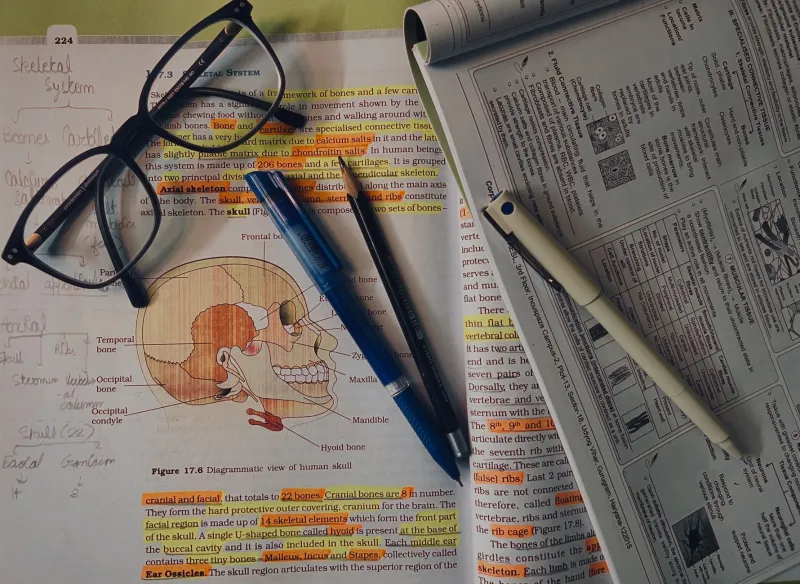
Stop Filling Every Line: Why the Empty Space in Your Notebook Is Doing More Work Than You Think

There's this thing that happens when you hand someone a brand-new notebook. Almost immediately, there's pressure — sometimes subtle, sometimes loud — to fill it up. Every line, every column, every corner. Leaving space feels wasteful, like you're not getting your money's worth. But here's the uncomfortable truth: that instinct to pack every millimeter is quietly killing your best ideas before they even have a chance to form.
The blank margin isn't dead space. It's breathing room. And if you've ever noticed that your sharpest thoughts seem to arrive in the shower, on a walk, or somewhere else entirely away from your desk, there's a reason for that. Your brain needs room to wander before it can land somewhere useful.
The Psychology of the Empty Page (Or Why Your Brain Loves a Little White Space)
Cognitive scientists have spent years studying what's sometimes called "incubation" — the mental process that happens when you step back from a problem and let your brain do its thing without pressure. What they keep finding is that the mind doesn't do its best connecting work when it's crammed full of inputs. It does its best work when it has space to roam.
Whitespace in a notebook functions the same way. When you leave generous margins around your notes, you're not just creating room for future additions — you're visually signaling to your brain that this information isn't finished yet. It's still open. Still in play. That psychological cue turns out to matter more than most people realize.
Designers have understood this for decades. Ask any experienced layout artist why they leave so much blank space around text in a brochure or a book, and they'll tell you it's not about aesthetics alone. The eye needs somewhere to rest before it can properly process what it's looking at. The same principle applies when you're the one doing the reading — and the thinking.
What Heavy Margin Users Actually Do Differently
Talk to people who've built serious note-taking practices — the executives who run tight meetings and still find time to think, the creative directors who consistently generate fresh concepts — and a pattern starts to emerge. They're not trying to transcribe everything. They're building space into their pages on purpose.
One common approach: the Cornell method, which divides a page into a wide right-hand column for main notes, a narrower left column for keywords and questions, and a bottom section for summaries. The structure forces you to leave room. And that left-hand margin — the one most people skip entirely — becomes a running index of your own thinking over time. You can flip back through a notebook weeks later and read just the margin column like a highlight reel of every meeting, book, or conversation that shaped a project.
Other people take a looser approach. They write on every other line, or only use the top two-thirds of a page, leaving the bottom as a "thinking zone" to return to later. Some executives keep a rule for themselves: never write more than five lines without leaving a gap. The gaps, they say, are where the connections happen.
What all of these systems have in common is intentionality. They're not accidental. The whitespace is planned.
Choosing the Right Paper for the Way You Actually Think
Here's where the physical product matters more than you might expect. Not all notebooks are built with margin-friendly note-taking in mind, and the paper you choose shapes your habits whether you realize it or not.
A few things to consider:
Line spacing and ruling. Wide-ruled paper gives you more breathing room between lines, which makes it easier to jot additions and reactions without crowding your original thought. College-ruled works fine for people with smaller handwriting, but if you're someone who writes large or likes to annotate heavily, wide ruling is your friend.
Pre-printed margins. Some notebooks come with a dedicated margin line already printed on each page — typically about an inch from the left edge. If you're not naturally disciplined about leaving space, this built-in guide does the work for you. It's a small thing, but it changes behavior.
Page size. A5 notebooks (roughly 5.5 by 8.5 inches) have become the go-to for a lot of professionals because they're portable but still large enough to leave meaningful margin space. Go too small and you're constantly cramming. Go too large and it can feel overwhelming to fill. A5 hits a sweet spot for most people.
Paper weight and texture. This sounds like a minor detail, but thicker paper — 90gsm and above — gives you more confidence to write freely. You're less worried about bleed-through, which means you're less likely to write in cramped, careful strokes. Looser handwriting naturally takes up more space, and that's actually a good thing for margin-based systems.
Making the Habit Stick: Practical Ways to Build Whitespace Into Your Workflow
Knowing that margins matter is one thing. Actually leaving them when you're in a fast-moving meeting or trying to keep up with a brainstorm is another. Here are a few approaches that actually work:
Draw your margin before you start. If your notebook doesn't have a pre-printed margin, take thirty seconds at the start of a session to draw one with a pencil. It's a tiny ritual, but it primes your brain for structured thinking before you write a single word.
Use the margin for questions, not answers. When you're taking notes, the main column is for what's being said. The margin is for what you're wondering. Questions, doubts, follow-ups, connections to other things. This separation keeps your notes cleaner and gives you a built-in agenda for after the meeting.
Review your margins separately. At the end of the week, flip through your notebooks and read only the margins. What patterns show up? What questions never got answered? What ideas keep appearing in different contexts? The margins become a kind of second layer of thinking — a meta-record of how your mind was working.
Give yourself a "no-write zone" at the bottom of each page. Leave the last quarter of every page blank during initial note-taking. Come back to it later as a summary space or a place to capture whatever surfaced after you'd had time to process.
The Real ROI of a Less-Crowded Page
Look, nobody's suggesting you buy a bigger notebook just to leave half of it empty. But there's a real return on the investment of intentional whitespace. When your notes are easier to revisit, you actually revisit them. When there's room to add context, you add it. When your pages breathe, your thinking tends to follow.
The best paper products aren't the ones that let you cram the most words into the smallest space. They're the ones that give you room to think — literally and figuratively. A well-made notebook with thoughtful ruling, a clean margin, and paper that handles your pen without complaint isn't a luxury. It's infrastructure for better work.
So next time you open a fresh page and feel that pull to fill every line, try resisting it. Leave some room. Your next best idea might be living in the blank space you almost didn't give it.