Writing in the Margins: The Low-Tech Decision-Making Habit That's Winning Boardrooms
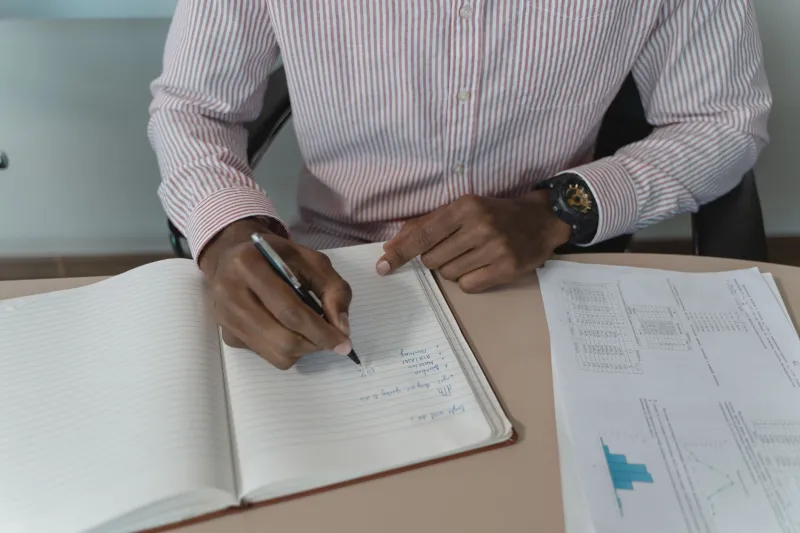
Somewhere between a quarterly earnings report and a final contract review, something interesting happens when a seasoned executive picks up a pen. They stop reading passively. They start thinking on the page.
It's called margin annotation — the practice of writing directly in the white space surrounding printed documents — and it's making a serious comeback at the highest levels of American business. Not because it's trendy, but because it works in ways that highlighting and digital comments simply can't replicate.
More Than Just a Note — It's a Thinking Tool
There's a real difference between underlining a sentence you agree with and writing "but what happens in Q3 if supply chain delays?" in the margin next to it. One is passive acknowledgment. The other is active reasoning.
Productivity coaches who work with C-suite clients have started calling this distinction "reactive vs. generative" reading. Reactive reading — the kind most of us do with a highlighter or a digital sticky note — confirms what's already on the page. Generative reading, the kind that happens when you're scribbling questions, pushback, and half-formed hypotheses in the margins, builds something new.
When your hand is moving, your brain is processing differently. The physical act of writing forces you to compress a complex thought into a few words. That compression? That's where clarity lives.
Why Executives Are Printing Again
Here's the thing: plenty of senior leaders never really stopped printing reports. But the way they're using those printouts has evolved. A decade ago, paper in the boardroom was about legacy habit. Today, it's a deliberate choice.
The shift has a lot to do with how information overload has changed the nature of executive decision-making. When you're reviewing a 40-page market analysis, a merger proposal, or a vendor contract, the volume of detail is enormous. Digital tools give you commenting features, sure — but they also give you notifications, hyperlinks, and the constant gravitational pull of your inbox.
Print removes all of that. It creates a closed system where the only thing that exists is the document and your thoughts about it. Margin notes become a record of your thinking in real time, without distraction.
Some executives take this further, developing personal shorthand systems — symbols for questions, concerns, action items, and points of agreement — that let them move through documents quickly while still leaving a rich trail of annotations. It's like building a second layer of meaning on top of the original text.
What This Looks Like in Practice
Imagine a VP of Operations reviewing a supplier contract before a major negotiation. She prints it out, reads through with a fine-point pen, and by the time she's done, the margins are alive with questions: "Who owns liability here if materials are delayed?" Next to a pricing clause: "Compare to last year's rate — we paid less." At the bottom of page seven: "This section contradicts what legal told us in March."
None of those thoughts would have been captured the same way in a digital comment. The act of writing them by hand — in her own words, in her own shorthand — means she walks into that negotiation not just having read the contract, but having processed it.
That's the competitive edge margin annotation creates. You're not just informed. You're prepared.
The Collaboration Angle
Here's where it gets really interesting for teams. Some high-performing organizations have started circulating physically annotated documents as part of their review process. A director reads a strategic plan and adds their margin notes. That copy goes to a VP, who reads both the original text and the director's annotations — then adds their own layer.
By the time the document reaches the decision-maker, it's a living artifact of the team's thinking. You can see where different stakeholders agreed, where they pushed back, and where nobody flagged a concern that maybe should have been flagged.
This is fundamentally different from a shared Google Doc with comment threads. Margin notes feel personal. They carry the weight of someone's actual handwriting — their hesitation, their emphasis, their energy. There's a reason handwritten feedback tends to be taken more seriously than a typed comment.
The Right Paper Makes a Difference
None of this works as well on flimsy copy paper. If you're printing documents for serious annotation, paper quality matters more than most people realize. Heavier stock — 24 lb or 32 lb bond paper — holds ink better, reduces bleed-through, and simply feels more substantial in your hands. That tactile quality isn't superficial; it signals to your brain that what you're holding is worth your full attention.
The margins themselves matter too. Documents formatted with wider margins (1.25" to 1.5") give you actual room to write legibly, rather than cramming thoughts into a half-inch strip. If you're regularly annotating reports for decision-making, it's worth reformatting your standard templates to accommodate this.
And yes, the pen matters. A fine-point rollerball or gel pen gives you control without dragging. You want to write quickly and legibly — not fight with your instrument.
Why Digital Comments Don't Quite Cut It
Let's be honest: digital annotation tools are genuinely useful. PDF markup, shared document comments, collaborative platforms — they all have a place. But they have a ceiling when it comes to deep, generative thinking.
For one thing, typing a comment is cognitively different from writing one. Typing is fast and frictionless, which sounds like a feature but can actually work against you. A little resistance — the act of forming letters by hand — slows your thinking down just enough to make it more rigorous.
For another, digital comments exist inside a system. They're indexed, searchable, and permanent in ways that can actually discourage honest thinking. There's something freeing about a margin note that's just for you — a thought you're still working through, a question you're not ready to ask out loud yet.
Getting Started Without Overthinking It
You don't need a system. You don't need a framework. You need a printed document, a decent pen, and the willingness to talk back to the page.
Start with the next report that crosses your desk. Print it. Read it with a pen in your hand. When something strikes you — a question, a concern, a connection to something else you know — write it in the margin. Don't edit yourself. Don't worry about neatness.
Do that a few times, and you'll start to notice something: your recall improves. Your questions get sharper. You show up to meetings with a clearer point of view.
That's not magic. That's just what happens when you stop being a passive consumer of information and start being an active thinker on the page. The margin isn't wasted space. It's where your best thinking happens.