Put the Laptop Away: Why Legal Pads Still Own the Conference Room
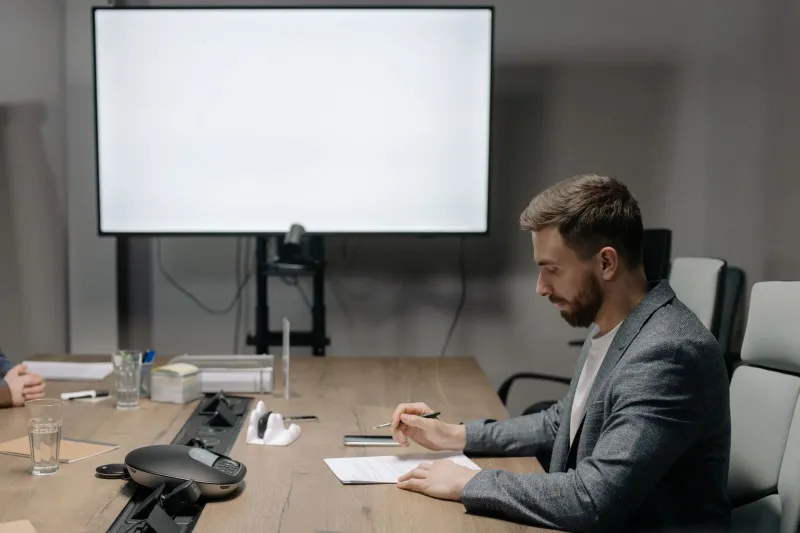
There's a moment in almost every important meeting when someone opens their laptop. The screen flickers on, fingers start moving across the keyboard, and suddenly the entire dynamic shifts. Are they taking notes? Checking email? Half-present at best? Nobody in the room knows for sure—and that uncertainty quietly costs everyone.
Now picture the executive across the table. She uncaps a pen, pulls a crisp legal pad closer, and starts writing. No one wonders what she's doing. Everyone knows. And somehow, without saying a single word, she's already the most credible person in the room.
This isn't nostalgia. It's strategy.
The Screen Problem Nobody Talks About
Laptops have become so normalized in American workplaces that we've stopped questioning whether they actually help. But the research is pretty clear: screens in meetings fragment attention. A study out of the University of Michigan found that the mere presence of a laptop—even a closed one—signals divided focus to other participants. Open one up, and you're fighting an uphill battle to convince anyone that you're fully engaged.
There's also the notification factor. Even with sound off, the visual pull of a blinking chat message or an email preview is hard to ignore. You might be taking meticulous notes, but the person presenting can't tell the difference between that and a quick scroll through LinkedIn. The doubt is already planted.
Paper doesn't have this problem. A legal pad communicates exactly one thing: you're here, you're listening, and what's being said matters enough to write down.
Why Legal Pads Specifically?
Not all paper tools are created equal for the boardroom. A spiral notebook feels a little too casual for a budget review. A pocket notebook is great for quick captures, but cramped for detailed meeting notes. The legal pad—that long, yellow (or white) staple of American professional life—hits a sweet spot that other formats just don't.
The size matters. A standard legal pad gives you room to work: space for headers, bullet points, action items, and the kind of margin scribbles that actually capture the subtext of what's happening in a room. You can sketch a quick org chart, circle a number for emphasis, or draw an arrow connecting two ideas without running out of real estate.
The format also signals professionalism in a way that's uniquely American. From law firms to C-suites, legal pads carry a visual shorthand that says serious work is happening here. It's a tool with institutional credibility baked in.
If you want to upgrade the experience, look for legal pads with heavier paper stock—something in the 24 lb to 32 lb range. Cheap pads bleed through, smear, and tear. A quality pad holds up under a confident pen stroke and doesn't distract you mid-meeting with a page that won't lie flat.
The Psychology of Being Fully Present
Here's something worth sitting with: when you're taking notes on paper, your body language changes. You're leaning slightly forward. Your eyes move between the speaker and the page. You're physically engaged in a way that typing simply doesn't replicate.
Other people notice this, even if they can't articulate why. Research on active listening consistently shows that visible engagement—nodding, eye contact, visible note-taking—makes speakers feel heard and respected. In a negotiation, a performance review, or a pitch meeting, that feeling is worth more than any bullet point captured in a shared doc.
There's also a cognitive benefit that's harder to fake with a keyboard. Handwriting forces you to synthesize. You can't transcribe every word, so you have to decide what actually matters. That filtering process means you're processing information more deeply in real time—and the notes you end up with are more useful because of it.
Building a Paper System That Works in the Room
Having a legal pad is one thing. Having a system is another. Here are a few approaches that executives and senior managers actually use:
The Two-Column Method: Draw a vertical line about a third of the way from the right margin. Use the left column for capturing what's said; use the right column for your own reactions, questions, and follow-ups. This keeps content and commentary separate without requiring two different documents.
Action Item Flagging: Develop a quick symbol system. A box next to a line means it's an action item. A star means it's a priority. A question mark means you need to follow up. You'll be able to scan a page of notes and pull out next steps in under a minute.
The Pre-Meeting Header: Before the meeting starts, write the date, attendees, and purpose at the top of a fresh page. It sounds simple, but this habit means your notes are always searchable and contextual—especially when you're flipping back through a pad weeks later.
Post-Meeting Transfer: At the end of the day, spend five minutes transferring action items to your task management system. The act of rewriting reinforces memory and ensures nothing falls through the cracks.
Choosing the Right Pen for the Room
A great legal pad deserves a pen that keeps up with it. In a professional setting, a ballpoint or gel pen in black or dark blue is your safest choice—legible, reliable, and appropriate for any environment. Keep a backup in your jacket pocket or portfolio. Running out of ink mid-meeting is the kind of small disruption that sticks in people's minds longer than it should.
If you're a heavier writer, a medium-tip gel pen gives you smooth, consistent lines without pressing hard enough to indent the page beneath. If you prefer a finer line, a 0.5mm ballpoint keeps things neat even when you're writing quickly.
The Competitive Edge You're Not Using
In an era when everyone is performatively busy—half-listening through a laptop screen, glancing at a phone, mentally composing a Slack message—the person with a legal pad and a good pen has a genuine edge. Not because paper is inherently superior to technology, but because full presence is increasingly rare, and rare things get noticed.
Decision-makers remember who made them feel heard. Clients remember who seemed genuinely engaged. Colleagues trust the person who wrote something down over the person who said they'd add it to a shared doc.
The legal pad isn't a throwback. It's a quiet, confident statement that you're the kind of professional who actually shows up. In a boardroom full of open laptops, that's a harder position to hold than it sounds—and a more powerful one than most people realize.