Dead Battery, Live Brain: The Science of Why Screens Off Means Ideas On

It happens to almost everyone. You're stuck on a problem — a pitch deck that won't come together, a product strategy that keeps circling back to square one, a client proposal that sounds flat no matter how many times you rewrite it. Then your laptop dies. Your phone is somewhere across the room. And ten minutes later, staring at a legal pad with a pen in your hand, something clicks.
That's not a coincidence. And it's not nostalgia.
There's a growing body of research — and a pretty vocal community of entrepreneurs, designers, and strategists — making the case that analog moments aren't interruptions to deep thinking. They are deep thinking. The question smart professionals are starting to ask isn't "why does this happen?" but "how do I make it happen on purpose?"
What's Actually Going On in Your Brain
Here's the short version of the neuroscience: your brain runs on two major cognitive networks that are, for the most part, in competition with each other. The first is the task-positive network — the focused, analytical mode you're in when you're responding to Slack messages, parsing spreadsheets, or clicking through browser tabs. The second is the default mode network (DMN), which activates during rest, mind-wandering, and unstructured reflection. The DMN is where your brain makes unexpected connections, revisits stored experiences, and generates what researchers sometimes call "insight thinking."
The problem? Screens are very, very good at keeping your task-positive network running on fumes. Notifications, auto-refresh, the low-level anxiety of an open inbox — all of it keeps your brain in reactive mode. The DMN barely gets a turn.
When your laptop dies, that loop breaks. Your brain, suddenly without a screen to process, starts doing what it was built to do when left alone: wander, connect, and synthesize. And if you happen to have a notebook nearby, you've got somewhere to catch what comes up.
The Intentional Blackout Movement
Some people aren't waiting for a dead battery to find out what their brain does without Wi-Fi. A growing number of professionals are deliberately engineering what you might call "analog windows" — stretches of time where screens are off, notifications are silenced, and the only input-output device is a pen and paper.
The practice goes by different names. Some call it a "digital sabbath." Others build in weekly "paper hours." A few companies have started running what they call "unplugged sprints" — short, structured sessions where teams work through problems using only whiteboards and notebooks before bringing anything digital into the conversation.
The common thread is intentionality. These aren't people who forgot their charger. They're people who figured out that their best strategic thinking was happening in airports and power outages, connected the dots, and decided to stop waiting for accidents.
What Pen and Paper Actually Do Differently
It's worth being specific here, because "writing by hand is good for you" can start to sound like generic wellness advice. The mechanisms matter.
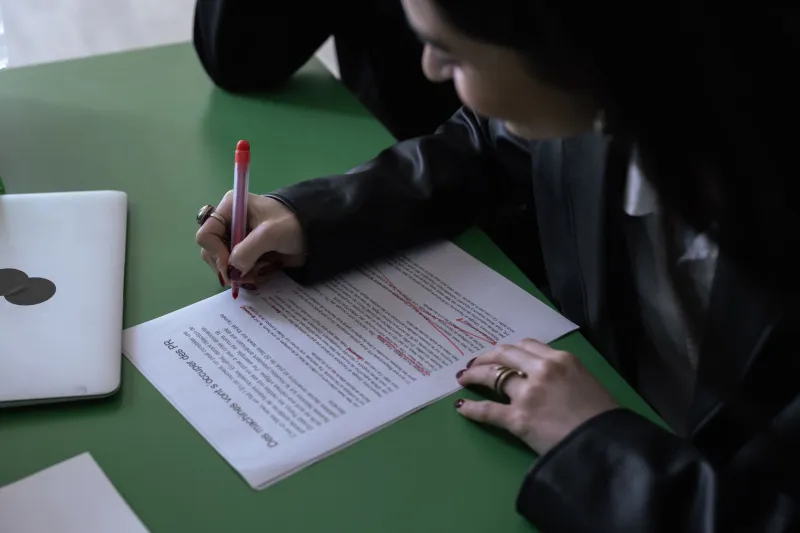
First, handwriting is slower than typing. That's not a bug — it's the feature. When you can't transcribe everything verbatim, your brain has to process and prioritize in real time. You're not recording; you're editing. That compression forces a kind of active engagement that passive typing doesn't require.
Second, a notebook doesn't talk back. There are no hyperlinks pulling you sideways, no suggested content, no algorithm deciding what you see next. The page is inert, which means your thinking has to be active. You supply the direction.
Third — and this one tends to surprise people — the physical act of writing seems to anchor abstract ideas more firmly in memory. Multiple studies have shown that people who take notes by hand retain conceptual information better than those who type, even when the typed notes are more comprehensive word-for-word. Something about the motor engagement deepens encoding.
Building Analog Moments Into a Real Workflow
So how do you actually do this without it feeling like a gimmick or a retreat from the tools your job depends on?
Start small. A lot of practitioners recommend a "paper-first" rule for new problems: before you open a browser or a doc, spend ten minutes with a notebook just writing out what you actually know about the challenge. No research, no templates, no existing frameworks. Just what's in your head. It's often surprising how much is already there — and how much clearer the actual problem becomes once it's written out by hand.
Another entry point is the meeting debrief. Instead of typing up notes immediately after a call or session, give yourself five minutes with a legal pad first. What was the real takeaway? What question didn't get answered? What's your gut reaction? That unmediated first pass often surfaces things that get lost when you jump straight to a structured document.
For bigger creative or strategic challenges, some professionals block out longer analog sessions — a Sunday morning, a long flight, a quiet hour before the rest of the office arrives. The key is removing the option to go digital, not just intending to avoid it. Put the phone in another room. Close the laptop. Make it a little harder to break the spell.
The Right Tools Make It Easier to Start
None of this requires anything fancy. But it does help to have paper you actually want to pick up.
There's a real psychological difference between grabbing a beat-up spiral notebook from the bottom of your bag and opening a well-made journal or a quality legal pad that feels substantial in your hand. The tactile experience matters — it signals to your brain that what you're doing is worth taking seriously. If your analog tools feel like an afterthought, your analog thinking probably will too.
A good pen helps too. Smooth ink flow, a weight that feels right in your grip, paper that doesn't bleed through — these details lower the friction between the idea and the page. And lower friction means more ideas actually make it out of your head.
The Paradox Worth Leaning Into
Here's the thing nobody tells you when you're optimizing your workflow with the latest app or productivity system: the most connected you can be to your own thinking is often when you're completely disconnected from everything else.
The dead battery isn't the problem. It might be the whole point. The professionals figuring that out fastest are the ones keeping a good notebook close — not as a backup plan, but as a deliberate first move.
Your best ideas are already in there. Sometimes they just need the screen to go dark before they show up.