Your Digital Notes Are a Black Hole. Here's How Paper Actually Keeps Ideas Alive.
Somewhere in your phone, there's a note you wrote eighteen months ago that probably would've changed something — a project direction, a pitch angle, maybe even a hiring decision. You'll never find it. Not because you lost it, technically. It's still there, timestamped and synced to the cloud. But for every practical purpose, it's gone.
This is the notification graveyard. And if you use any combination of Apple Notes, Notion, Evernote, Google Keep, or the voice memo app you forgot existed, you've buried things there.
The uncomfortable truth about digital note-taking isn't that the tools are bad. It's that they're almost too easy. Capture something in two seconds, file it nowhere in particular, and move on. The friction is so low that the act of writing it down doesn't actually mean anything to your brain. It's the cognitive equivalent of telling yourself you'll remember to grab milk and then walking right past the dairy aisle.
Paper works differently. And the reasons why are more interesting than you might expect.
The Capture Problem Nobody's Talking About
Productivity culture has spent years obsessing over capture — the idea that you should get every thought out of your head and into a trusted system as fast as possible. The logic is sound. The execution, for most people, has quietly fallen apart.
The issue isn't capture volume. Most professionals are capturing more than ever. The issue is retrieval and action. What percentage of the things you write down do you actually return to, develop, or use?
For digital notes, that number tends to be depressingly small. Studies on memory and learning have consistently shown that the act of typing is processed more shallowly than handwriting. When you type a note, your brain is essentially transcribing. When you write by hand, you're forced to summarize, interpret, and encode — which means the idea gets processed more deeply before it even hits the page.
That deeper processing creates something digital tools simply can't replicate: a memory trace. You don't just have the note. You remember writing it.
Why Paper Forces You to Be Intentional (Whether You Like It or Not)
Here's the thing about a physical notebook: it has exactly zero organizational features. No tags, no folders, no search bar, no AI-generated summaries. That sounds like a liability. In practice, it's one of paper's greatest strengths.
Because paper can't organize itself, you have to decide what matters. You can't dump every passing thought into a notebook the way you can into an app, then let the interface sort it out later. You slow down slightly. You make a choice about whether something is worth the ink.
That small moment of friction — pausing to write rather than tapping to type — is where the magic happens. Ideas that make it onto paper have already passed a basic quality filter: you decided they were worth your attention. That's not a small thing.
Creative professionals who've made the switch to paper-based capture systems often describe the same experience: their notebooks feel more like thinking than their phones do. The act of writing becomes part of the idea-development process, not just a storage function.
What Gets Lost in the App Ecosystem
Let's be honest about what digital tools are genuinely great at. Searchability is real. Sharing is easy. Cloud sync means you don't lose everything if your notebook gets left on a flight to Chicago. These are legitimate advantages, and nobody's asking you to throw your laptop into the ocean.
But the app ecosystem has a specific failure mode that paper doesn't share: out of sight, out of mind is built into the design.
Digital notes live behind icons, inside folders, underneath notification badges. Your phone is competing with itself constantly — every app is vying for the same screen real estate. An idea you captured on Tuesday is buried under Wednesday's Slack messages, Thursday's email previews, and whatever news alert your phone decided you needed at 7 a.m.
A notebook on your desk doesn't compete with anything. It just sits there, quietly available, not asking for your attention but ready when you bring it. There's no algorithm deciding whether your Tuesday idea deserves to surface again. You're in charge of that, which means you actually are.
Building a Paper System That Doesn't Fall Apart
The goal isn't to use paper for everything. It's to use paper for the things that matter most — the ideas and decisions you actually need to act on. Here's a practical framework that works for a lot of people.
The Daily Capture Page. At the start of each day, open to a fresh page. That's your capture zone for the next eight hours. Random ideas, questions that surface in meetings, things you want to research — it all goes here. One page, one day. No folders required.
The Weekly Review Pass. Once a week, flip back through your recent pages and circle or star anything that still feels relevant. If it doesn't earn a mark after a week, it probably wasn't as important as it seemed. If it does, transfer it to a dedicated section of your notebook — a project page, a running ideas list, or a simple "to develop" column.
The Standing Idea Notebook. Keep a second, smaller notebook specifically for bigger ideas — concepts you're developing, recurring themes, things you want to revisit over time. This is your idea archive, not your daily dump. Treat it with a little more care. Good paper matters here; you'll handle it more and it should hold up.
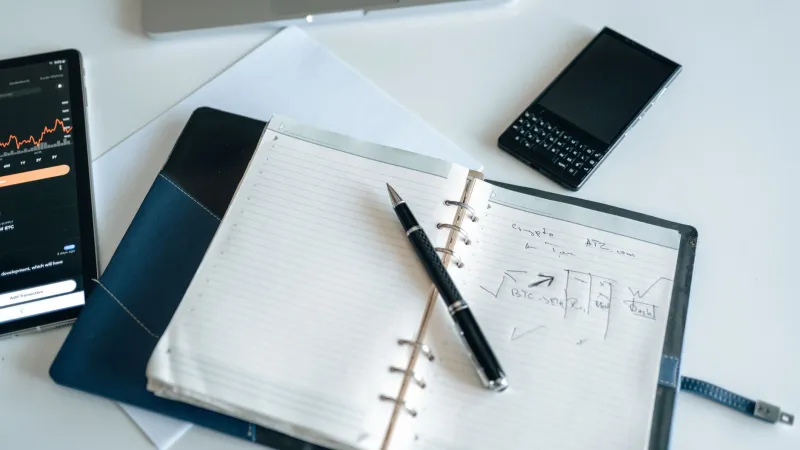
The Physical Trigger. Put your notebook somewhere you'll actually see it. On top of your keyboard. Next to your coffee maker. At the corner of your desk where your eye naturally lands. If it's in a bag or a drawer, it's already competing with the digital graveyard.
The Part That's Hard to Quantify
There's something that productivity frameworks don't fully capture, and it's worth naming: writing by hand feels different. It slows you down in a way that's actually kind of pleasant. There's a tactile quality to pressing pen to paper that typing just doesn't replicate, and that physical experience seems to signal to your brain that what you're doing matters.
That might sound soft, but it shows up in real outcomes. People who use paper-based systems report feeling more in control of their workload, more connected to their ideas, and less overwhelmed by the volume of information they're managing. That's not nothing — especially if you're someone who opens their notes app and immediately feels a low-grade anxiety about everything in there.
Paper doesn't have to replace your digital tools. But if your best ideas keep dying somewhere between the capture and the follow-through, it might be time to give them a better place to land.
Your notebook isn't a backup system. It might just be your primary one.